


IS Google Search Being Replaced by AI

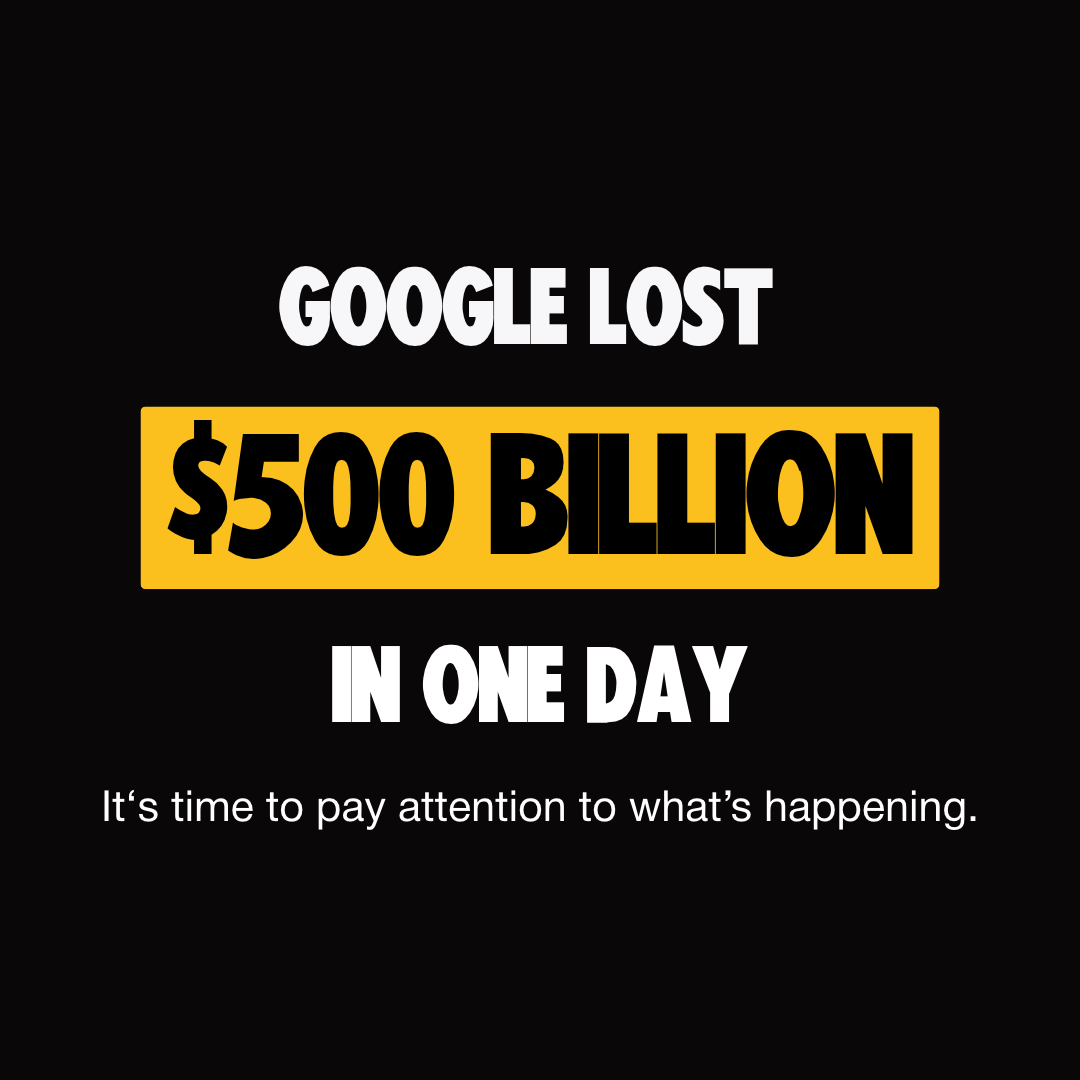
Nearly $500 billion wiped off Google's parent company in a single day.
The undisputed king of search is under pressure. Is this the beginning of the end for Google as the world's most valuable marketing channel?
For decades, Google has dominated how consumers discover businesses, research products, compare suppliers and make purchasing decisions. They owned it all.
But AI is fundamentally changing consumer behaviour across B2C and B2B.
Consumers are no longer simply searching, trying to make sense of what they see with a potentially uninformed opinion. They are now able to ask complex questions, validate opinions, compare suppliers and reviews, and use AI platforms to narrow their choices before ever visiting a website.
AI has helped generate an abundance of information and connect multiple channels, helping users funnel their thoughts and make more informed decisions.
And unlike some of the hype circulating online, there's now credible, independently conducted research showing how these changes are affecting consumer behaviour and, ultimately, how that's affecting businesses.
So, should businesses abandon Google Search, Google Business Profiles, Google PPC and put all their chips into AI?
No. Not a chance!
Let's geek out and see what the data is trying to tell us. Buckle up, this gets deep.
Why Did Google Lose Nearly $500 Billion in Market Value?
In October 2026, Alphabet experienced a share-price collapse that erased nearly $500 billion from its market capitalisation.
That's nearly half a trillion dollars in lost market value. Not lost sales or operating revenue, but a significant reassessment of the company's valuation by investors.
The more interesting story lies in Google's own financial results.
According to Alphabet's Q3 2026 earnings announcement:
- Google Search and other advertising revenue increased 12% year-on-year, reaching $63.35 billion.
- Alphabet's total revenue grew 25%, reaching $127.6 billion.
- Google reported its fastest year-on-year search query growth in five years.
So, despite what you read, Google Search isn't falling apart. It's still growing.
However, during the company's official earnings call, Google's Chief Business Officer, Philipp Schindler, acknowledged that the growth of AI Mode was contributing to slower Search advertising revenue growth because AI Mode searches currently generate less advertising revenue.
Importantly, Philipp identified foreign exchange movements as the largest factor behind the quarterly slowdown, alongside industry-specific advertising trends.
Alphabet's financial filings also showed $51.4 billion in quarterly capital expenditure, compared with $42.3 billion in operating cash flow.
It's not that Google has stopped making money. It's that the transition to AI presents significant questions about future advertising economics and investment returns.
And for businesses investing thousands, or hundreds of thousands of dollars or pounds in search advertising, those questions are well worth paying attention to.
Is AI Really Changing How Customers Search?
Here's where things become interesting.
In June 2026, the independent Pew Research Center published a study based on a survey of 5,119 American adults. While that sample may seem small, it's a significant number of participants.
The findings were interesting:
- 42% of US adults reported using AI chatbots to search for information.
- 60% said they had read AI-generated summaries in search engine results.
- Around half of US adults reported using AI chatbots, with approximately one-quarter using them daily.
These are US findings, not UK-specific figures, but they demonstrate that AI-assisted information discovery has moved well beyond the early-adopter stage and well beyond typing a loose idea of what you want into Google and scrolling through endless blue links, hoping to narrow down your thoughts.
And the changes don't stop there.
AI Is Changing What Happens After Someone Searches.
In a separate Pew Research Center study published in July 2025, researchers examined Google search activity from 900 US adults.
Their analysis covered 68,879 unique searches, so again, a fairly significant sample.
The findings:
- 15% of searches without AI summaries resulted in a click on a traditional search result.
- Only 8% of searches with an AI summary resulted in a traditional result click.
- Just 1% of visits to pages with AI summaries resulted in a click on a source cited within the summary.
That's a substantial difference in observed website referral behaviour. So, if you've seen a dip in website traffic this year, this could be a clue as to why.
Now, it's important to understand what the research proves and what it doesn't.
This was an observational study. It demonstrates an association between AI summaries and reduced clicking behaviour, not definitive proof that AI caused every reduction.
But from a marketing perspective, the implication is obvious.
If customers can find the answers they need without clicking through to your website, how does that change your customer acquisition strategy?
For businesses dependent on organic search traffic, this is a question that deserves urgent attention.
Customers Are Moving From Searching to Researching With AI.
Think about how somebody might research your product or services.
Traditionally, they might search Google, visit several websites, look at some of your content, read a few reviews, compare suppliers and build a shortlist.
This may take several visits or several days.
Today, they can ask an LLM to do all of this in seconds and ask for advice about what they should consider before taking action.
LLMs can support search in ways Google traditionally couldn't.
They can:
- Recommend suppliers based on specific requirements.
- Compare products, pricing and functionality.
- Explain the advantages and disadvantages of each option.
- Challenge assumptions about what customers need.
- Help customers narrow their shortlist before contacting a supplier.
And if your business doesn't have the right content, in the right places, in the right format... you don't make the list.
You are invisible!!!
That's scary!
A separate peer-reviewed 2025 experiment involving 211 participants, published in the Journal of Theoretical and Applied Electronic Commerce Research, found that participants preferred traditional search engines to AI chatbots when evaluating product information, partly because search engines felt more familiar.
The study used a student sample and static interfaces, so its findings also have limitations.
What does this tell us?
AI is becoming an important information-discovery channel, but traditional search still has clear strengths.
Good news.
The evidence supports a changing and increasingly fragmented customer journey, not the complete replacement of Google.
And this is why, at Marketing Sales Management, we are advocating for every business to review its customer journey and start testing new channels, content and funnels to prepare for what's to come.
We explore why businesses need to understand these different buying stages in our guide to full-funnel marketing and the modern customer journey.
So, Back to Our Original Question... Should Businesses Abandon Google and Invest Everything in AI?
No...
Google still captures enormous commercial intent and is still, without question, the dominant channel. Its role in connecting multiple channels and helping you understand how your marketing channels work is essential.
When someone searches for a specific product, supplier or service, they're actively expressing a need, signalling interest.
And depending on the market, that could make Google and Google PPC some of the most profitable acquisition channels available, depending on your business niche.
But there's an important distinction between capturing existing demand and influencing future demand.
Google is often highly effective at reaching customers who already know what they're looking for.
AI platforms can influence what customers research, which options they compare and which brands enter their consideration set, helping searchers understand what they're looking for.
That's the important bit. LLMs are influencing almost every stage of the funnel.
Meta, email marketing, organic search, video and other content channels also contribute to that process.
So the question isn't which single channel wins. It's how different channels work together to generate more qualified leads and profitable customers.
And this is where attribution becomes tricky.
The Channel Getting the Final Click Isn't Always the Channel That Created the Opportunity.
Imagine this customer journey.
A potential customer discovers your company through LinkedIn.
A week later, they ask an AI assistant to recommend suppliers.
Your business appears in the recommendations, and they recognise you. (That builds confidence.)
They visit your website, leave without enquiring, see a Meta advert a few days later and eventually search for your company by name on Google.
They land on your Google Business Profile and see examples of your work, reviews and some indication of price.
They click a PPC advert and submit an enquiry.
Google Ads reports the conversion.
Great!!!
But did Google create that customer, or did it simply capture the final interaction?
Confused much?
A peer-reviewed study published in Econometrica in 2015, Consumer Heterogeneity and Paid Search Effectiveness: A Large-Scale Field Experiment, examined paid search advertising through large-scale experiments at eBay.
Researchers found that conventional attribution methods substantially overstated the incremental effectiveness of certain paid search campaigns.
In that particular setting, branded keyword advertisements produced no measurable short-term incremental benefit, while advertising was more effective for some new and infrequent customers.
That doesn't mean branded PPC is ineffective for every business. It means advertising performance cannot always be established by counting attributed conversions.
Some customers may have purchased anyway.
Others may have been influenced by other marketing channels that received no conversion credit, reflecting the influence of multiple touchpoints throughout the customer journey.
This is exactly why we believe conversion rate optimisation is bigger than your website.
Every touchpoint has a BIG role to play in generating the final sale.
The challenge is understanding which activities genuinely create incremental revenue and which metrics you should measure to find the answer.
- Google Search Console
- Google Analytics
- Microsoft Clarity
- CRM data
- Email engagement data
- Website engagement data
- Paid ad data
We are not short of platforms to show us the numbers.
How Should Businesses Test Their Marketing Channels?
Don't just blindly redistribute your marketing budget or "just put a couple of grand into Google or ChatGPT Ad Manager".
You should continue with what works, allocate a small percentage of your budget to a new channel, define what good looks like, establish what you'll measure and then review.
The strongest marketing strategies aren't built around loyalty to Google, Meta, LinkedIn or the latest AI platform.
They're built around evidence.
Here's where we would start.
Protect What's Already Working.
Before changing your marketing strategy, establish which channels currently generate profitable customers.
Review your Google PPC, organic traffic, Meta advertising, email marketing and other acquisition channels.
Understand:
- How many qualified enquiries each channel generates.
- How many enquiries become paying customers.
- What it costs to acquire those customers. Track CPA (cost per acquisition) and CPL (cost per lead), alongside ROAS (return on ad spend), which measures revenue generated relative to advertising spend.
- What the average order value is from those channels.
If a channel is delivering profitable growth, protect it and scale that channel as much as you can.
If you're spending heavily on PPC but struggling to generate leads, investigate your website CRO and sales process before increasing your budget or turning that campaign off.
What leads see next after clicking on a campaign can make or break what they do next.
A crap website or landing page will kill more leads than anything else.
We've covered that issue in more detail in Don't Touch Paid Ads Until Your Website Actually Converts.
Experiment With AI Visibility and Discoverability.
Start by understanding how your business appears across AI platforms.
Ask the questions your prospective customers might ask and record what you find.
- Does your company appear, and does the platform cite any of your content or statements?
- Which competitors are recommended?
- Are the recommendations accurate?
- What information are those platforms using to form their answers?
Then identify opportunities to improve your content, authority and discoverability.
I can't stress this enough. Blogs and YouTube videos (content) are absolutely king here, and guess who supports both of those channels?
Google!
An older but still relevant peer-reviewed research paper presented at ACM KDD 2024, titled GEO: Generative Engine Optimization, demonstrated improvements of up to 40% in visibility within its experimental generative-search benchmark.
But don't confuse a benchmark improvement with a 40% increase in sales. And don't blindly trust a document that's a couple of years old, as the world is moving fast.
While the study provides evidence that content optimisation can influence AI-generated visibility under experimental conditions, it doesn't establish a guaranteed commercial return for businesses.
That still needs testing.
And if you don't have a budget for experimentation, find a way to create one.
Start small if necessary.
Just don't assume your existing marketing channels will retain the same effectiveness indefinitely.
From what we're seeing at MSM, search behaviours are changing fast, and the content being consumed is changing just as quickly.
Important Note... Measure What Matters.
This is where many businesses lose the plot or the will to live.
They're obsessed with clicks, impressions, traffic, engagement and going bloody viral.
All useful indicators and aspirations, but none automatically means your business is making more money.
When testing new channels, measure:
- Visibility: Are relevant customers encountering your business?
- Traffic: Which channels and touchpoints are generating qualified visits?
- Leads: Are you attracting genuine commercial opportunities?
- Conversions: What proportion become paying customers?
- Revenue: Are you generating additional profitable business?
Use AI visibility metrics as supporting evidence, not the final measure of commercial success.
Where possible, use controlled tests, geographic experiments or other suitable holdout methods to distinguish incremental results from sales that would have happened anyway.
And ensure your CRM connects marketing activity to the sales pipeline.
Otherwise, you're making budget decisions without understanding the commercial outcome.
If you're looking to generate more revenue from your existing marketing investment, read our guide to increasing B2B lead generation without increasing advertising spend.
Final Note.
Follow the evidence, not the hype, and start testing now.
You'll thank us this time next year.
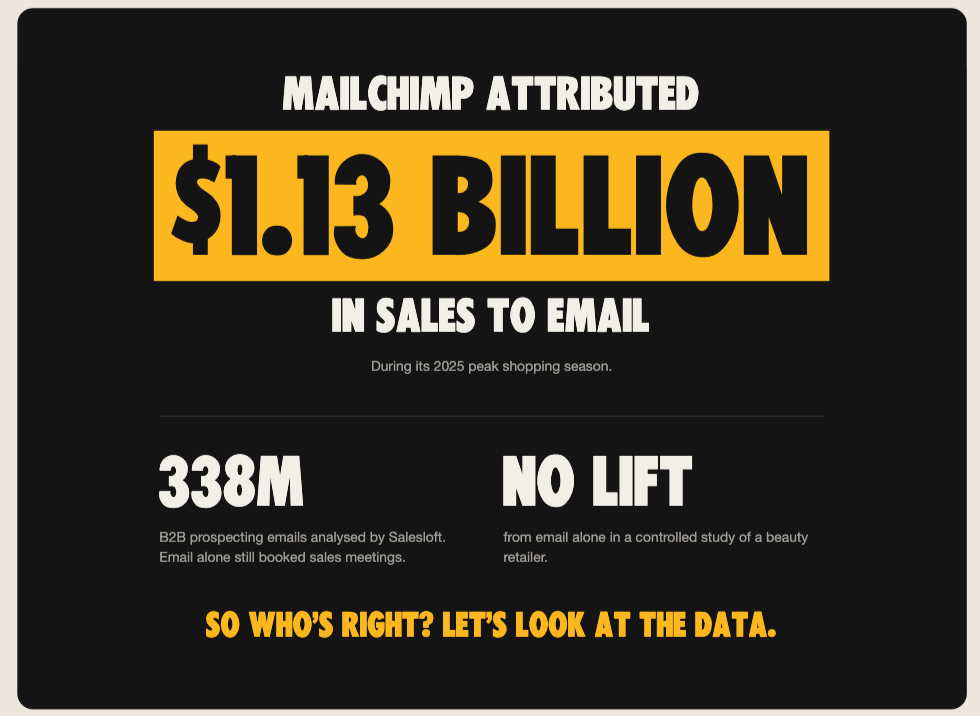
We've reviewed research from major marketing platforms, independent research organisations and academic studies to find the truth. What we found wasn't what we expected.
What most CRM specialists won't tell you about CRMs because it could cost them the sale.