


Is Email Marketing Dead

Is Email Marketing Dead? Do Emails Still Generate Leads?
Email marketing has been pronounced dead more times than I care to remember, but I've never been convinced.
At MSM, we send more than 10k emails every week, and they've never failed to generate results for us. That doesn't mean every email wins a customer. We send different emails for different reasons.
Some raise awareness of a problem. Some help people understand a subject. Some bring visitors to our service pages, blogs and research. Others let us test ideas at scale, so we've got evidence to share with our clients. And when more people discover our content, that supports the wider work we're doing around search visibility, SEO and AEO.
But here's the BIG question. True or false: do emails still generate leads?
Our own experience tells me yes, but the research challenged our opinion more than we thought! Let's see if email marketing still works across other businesses in 2026, when there are plenty of other places to spend your marketing budget.
To help answer that question, we've looked at original research from major marketing platforms, independent research organisations and academic studies. We've included evidence that supports email, evidence that challenges it, and the bits the industry still can't prove.
For those with a short attention span, the short answer is yes. Email marketing can generate website traffic, leads, customers and revenue. But sending an email to a complete stranger isn't the same as emailing someone who abandoned a basket last night, or a business that bought from you two years ago. Those are different jobs, and they deserve different strategies and measures.
What did the research tell us?
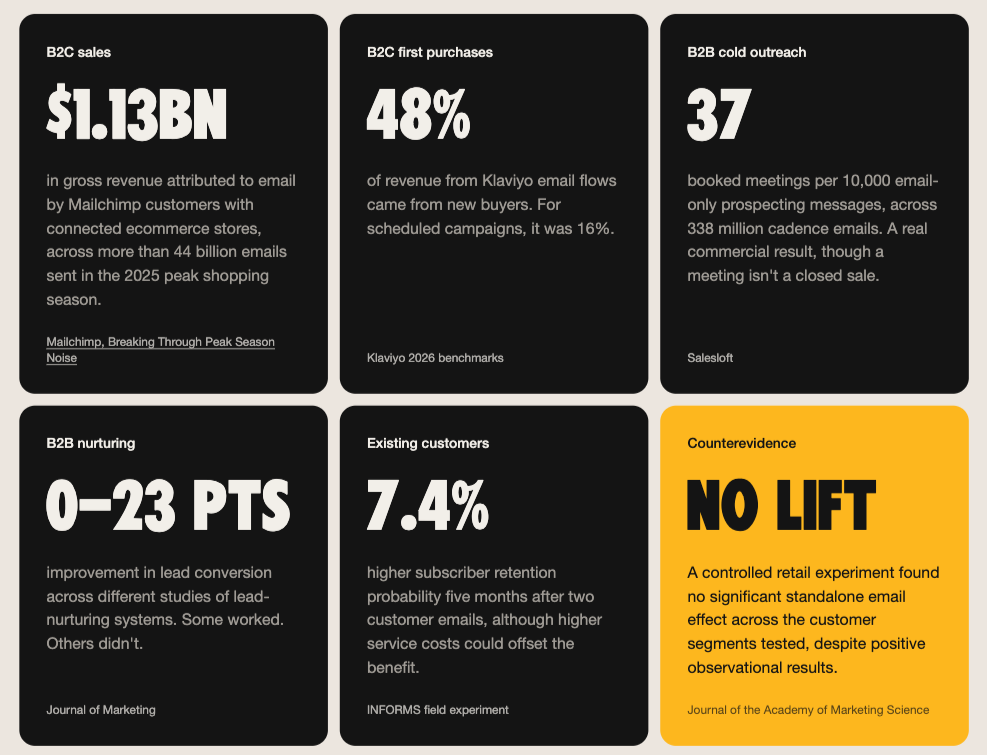
These six findings are a good place to start.
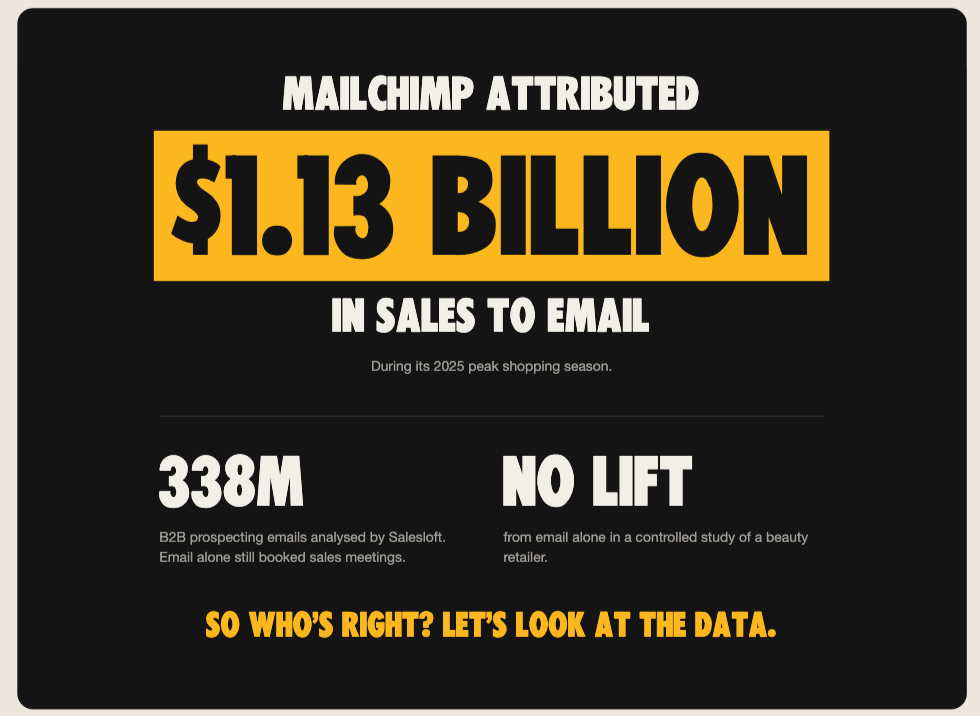
- $1.13 billion in attributed sales. Mailchimp reported that figure for email during the 2025 peak shopping season, based on connected ecommerce stores. That's revenue linked to email campaigns, not a survey asking marketers how they feel. Mailchimp's research.
- Almost half of one category of email revenue came from new buyers. Klaviyo found that nearly 48% of revenue attributed to automated email flows came from first-time customers. Klaviyo's benchmarks.
- 37 B2B meetings for every 10,000 prospecting emails. Salesloft measured that in an analysis of 338 million emails. Those are meetings, not signed contracts. Salesloft's study.
- Warm leads can move closer to a sale. A peer-reviewed study found that lead-nurturing programmes changed conversion probability by between zero and 23 percentage points, depending on the setting. Journal of Marketing research.
- Retention can improve. A controlled experiment found that two engagement emails increased subscriber retention probability by 7.4% after five months. The original field experiment.
- Some emails make no measurable difference to sales. A separate controlled retail experiment found no statistically significant standalone email effect in the groups it tested. Journal of the Academy of Marketing Science.
So it's not a case of every email working. It's a case of whether email marketing works at all. And we've got evidence that it does. Now let's look at what happens at different stages of the buying journey.
Are emails still generating sales from B2C email marketing?
For ecommerce businesses, we've got something useful: purchases that can be traced back to a campaign through a connected store. We don't have to rely on opens or clicks alone.
That doesn't mean an email caused every penny of attributed revenue. Someone may have bought anyway. But it does mean a business can see what people purchased after engaging with its campaigns.
Getting someone to buy for the first time
Klaviyo analysed data from more than 183,000 customers for its 2026 benchmarks. It found that automated flows accounted for almost 41% of email-attributed revenue, even though they represented only 5.3% of sends. Nearly 48% of that flow revenue came from new buyers, compared with around 16% for scheduled campaigns. See Klaviyo's original figures.
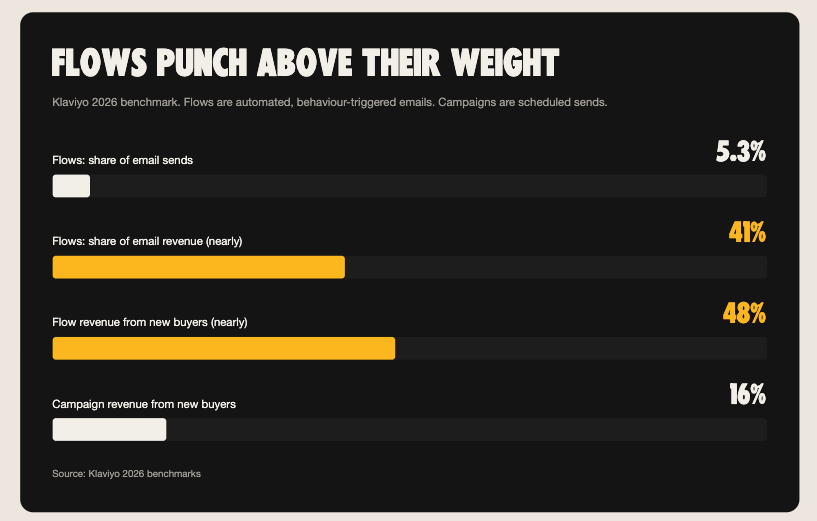
Think about the difference. Someone signs up, reads a welcome email and places their first order. Someone else has bought five times and receives a new-product announcement. Both sales can be attributed to email. Only one is a new customer.
It's also worth separating email from automation. Automation is how you send a message at the right time, often as part of a series. It isn't a different channel. A one-off email can generate a lead just as a scheduled sequence can. What matters is what the recipient does next.
Do normal email campaigns make sales, or is it all abandoned baskets?
Normal campaigns make sales too.
Klaviyo reported a 0.16% placed-order rate for scheduled campaigns, compared with 2.11% for flows. That's a big difference, but I'd be careful about treating it as a fair contest. Someone who's left items in a basket is already showing buying intent. A general newsletter goes to people who may not be shopping at all. Klaviyo campaign and flow benchmarks.
Mailchimp gives us another measure. Its research covered more than 44 billion emails sent from 31 October to 31 December 2025. For businesses with connected ecommerce stores, it recorded approximately $1.13 billion in gross email-attributed revenue. SMS accounted for approximately $8.2 million separately. Read Mailchimp's report.
Does that prove every business should spend more on email? No. It's a peak-shopping-season dataset, and it doesn't tell us what share of those purchases would have happened without the campaign. But it's strong evidence that email is connected to real orders, not just website activity.
What about abandoned baskets and customers who've stopped buying?
This is where the purpose of the email becomes important.
Klaviyo's lifecycle benchmarks reported $6.77 per recipient for abandoned-basket emails, $5.75 for welcome emails, $2.08 for browse abandonment, $1.80 for post-purchase emails and $0.82 for win-back. These are attributed revenue figures, not profit. Source: Klaviyo's 2026 lifecycle benchmarks.
An abandoned-basket reminder earned around 8x as much per recipient as a win-back message in that dataset. I wouldn't take that as a reason to abandon win-back. Someone who's gone quiet for six months isn't in the same position as someone who nearly paid yesterday. The important point is that BOTH generated attributed revenue.
Omnisend's analysis of 27 billion emails from 150,000 brands tells a similar story. Behaviour-triggered emails represented just 2% of sends but accounted for 30% of email-attributed revenue. That's useful evidence about timing and audience intent, not proof that the software is doing the selling. Omnisend's 2026 report.
Do emails keep existing customers buying?
There's more to this than platform attribution.
In a peer-reviewed field experiment with a subscription business, sending two engagement emails increased the probability of customer retention by 7.4% five months later. That's a controlled result. It's evidence that the emails changed behaviour rather than simply appearing somewhere along the customer's journey. Read the experiment.
But the researchers found a catch: some customers used more services and became less profitable. Retaining a customer doesn't always mean making more money from them.
Is B2C email getting better or worse?
We've got some year-on-year evidence, but not enough to declare a universal trend yet.
Listrak reported that triggered and transactional emails accounted for 45% of email-attributed revenue in 2024 and 49% in 2025 in its comparable client dataset. That's a growing share of email revenue; it doesn't mean total sales increased by 4%. Listrak benchmark report.
There are less flattering results too. In nonprofit fundraising, M+R reported an 11% average fall in email-sourced revenue in 2024, followed by a 16% average increase in 2025 in the next annual study. They're separate study groups, and fundraising isn't the same as ecommerce. But they make one point very well: email revenue doesn't rise every year just because you're sending emails. M+R 2025 and M+R 2026.
My take on B2C
The evidence is pretty clear. Email marketing still brings in first-time buyers, generates repeat sales and encourages customers who've gone quiet to come back and buy again.
And here's what makes it even more attractive. Email remains one of the most cost-effective marketing channels available. You're not paying for every click, you have direct access to your audience, and you've got far more control over when and how you communicate with them.
Of course, profitability still matters. But there's also a longer-term benefit that's easy to overlook. Not every email needs to generate an immediate sale to have value.
Sometimes it's about staying in front of your customers, giving them a reason to return and making sure they think of your business when they're ready to buy.
Because in a competitive market, it's far better to stay remembered and relevant than to be forgotten.
Do emails still generate leads for B2B?
This is where I think some of the conversation around email goes wrong. And after decades of working in B2B, it's way more complicated.
Sending a cold prospecting email to a business you've never spoken to is one thing. Emailing someone who downloaded your guide is another. Sending a useful update to an existing customer is something else again.
If we're asking whether B2B email marketing works, we need to look at all three, not treat a cold-email reply rate as the answer to everything.
Does cold email still generate leads?
Yes. Salesloft analysed 338 million prospecting emails sent by 65,413 sellers. Email-only outreach produced 37 booked meetings for every 10,000 emails. When sellers combined roughly one telephone call with each email, the figure was 166. Salesloft's original research.
Gong analysed more than 28 million cold emails and found an average of 344 emails for every booked meeting. That's another large dataset showing that cold email can create a sales conversation. Gong's study.

I wouldn't put the two studies together and pretend we've discovered one industry average. They studied different sellers and different processes. I also wouldn't call a meeting a sale. But if someone tells you cold email can't generate a lead, these figures are a pretty good challenge to that claim.
Salesloft's figures also suggest that combining email with telephone outreach may produce more meetings. The researchers weren't running a controlled experiment, so we can't say every extra meeting was caused by calling. Still, it would be a mistake to assume email has to work alone to have commercial value.
Just from our own experience at MSM. We send 10k emails per week. We typically get three or four booked meetings per month.
What impacts that, I hear you ask? Bad content.
Of course, there's more to it. Who you're emailing, what you're offering and when you send it all matter. And not all 10k emails are trying to book a meeting. Some raise awareness, educate people or bring visitors back to our website. So we can't fairly compare our overall meeting rate with research looking purely at cold sales prospecting.
The point is to measure each email against what you sent it to achieve.
What about people who've already shown interest?
Say someone's visited your website, downloaded a guide, attended an event or asked for a quote. They've already given you a reason to follow up. At this stage, that's not cold prospecting or new lead generation. This is lead nurturing.
A 2025 Journal of Marketing study found improvements in lead-conversion probability ranging from zero to 23 percentage points across different lead-nurturing settings. In some cases the activity helped; in others it made no detectable difference. Read the academic study.
Adobe's AvidXchange customer research also reported more than doubling opportunities after improvements to segmentation and marketing automation, including email nurturing. That was a wider programme, so we can't fairly hand the entire result to email alone. AvidXchange case study. But again, this improvement was based on better segmentation and CRM systems that allowed the business to improve how the campaign was controlled.
That matters for B2B email marketing because some campaigns are meant to start a relationship, while others help an existing prospect take the next step.
Existing customers and prospects who've gone cold
So imagine a customer you haven't heard from for six months. Or a proposal that went nowhere. Or somebody who liked your service but wasn't ready to buy. You don't need to introduce yourself all over and over again. You need a good reason to get back in touch. A good value exchange!
BNY Mellon Investment Management reported 142% more website visits and 314% more repeat visits from personalised journeys than from non-personalised ones. These results concern email-related engagement with existing contacts. They don't tell us how many extra contracts were signed, though. Adobe's BNY Mellon case study.
I found examples of lost-lead reactivation and customer campaigns producing results. What I didn't find was a dependable, independent, large-scale figure for revenue generated by B2B win-back emails or renewal campaigns. So I wouldn't put a made-up conversion rate in front of you.
Anecdotally, from our own experience at MSM and the customers we support, win-back and customer reactivation campaigns using email have worked. They've helped reopen conversations with lost prospects, bring dormant customers back and generate new opportunities.
But we keep coming back to the question of attribution.
In B2B, particularly when you're dealing with higher-value products or services, you might send someone a well-written email campaign and then pick up the phone a few days later. If that person goes on to buy, which channel gets the credit?
Here's a perfect example from this morning. My insurance company called me about renewing my policy. I'd already received an email with a link to renew, but I hadn't taken any action. I was planning to renew anyway. So was it the phone call that secured the renewal? Was it the email that reminded me it was due? Or was I always going to renew regardless?
Who gets the credit for that conversion?
If we use last-touch attribution, the phone call could get the credit. If we use first-touch attribution, the email might. If we use multi-touch attribution, both could receive a share. But none of those models proves which interaction caused the sale.
And that's one of the biggest challenges when measuring the effectiveness of email marketing, particularly in B2B. The email might raise awareness, explain the offer, address concerns or give someone a reason to consider buying. The phone call might provide the final push. Neither necessarily works in isolation.
That's why I think it's a mistake to judge email marketing purely on the number of sales directly attributed to the last email someone clicked. Sometimes email generates the lead. Sometimes it helps move an existing opportunity forward. And sometimes it keeps your business in someone's mind until they're ready to make a decision.
The challenge isn't just measuring whether an email was sent, opened or clicked. It's understanding the contribution it made to the eventual sale.
Forrester's buyer research adds context: 68% of B2B buyers entered a purchasing process with a preferred vendor already in mind. It doesn't prove email created that preference. It does show why staying known to buyers matters long before the sales team gets a call. Forrester's research.
My take on B2B
Cold email produces meetings. Follow-up emails can move warm leads along. Campaigns to existing contacts can get people back to your website and into conversations. Proving precisely how much closed-won revenue email caused is harder, especially when the sale involves several people and several channels.
That doesn't mean the email had no value. It means we need to look at its job in the wider sales process, not just which touchpoint happened to come last.
Can an email campaign increase website traffic?
Hell yes! This one's much easier to prove.
Put a properly tagged link in an email, and Google Analytics 4 can identify sessions from that campaign. You can then look at what those visitors did: read a blog, visit a service page, submit an enquiry, request a demo or make a purchase. Google's UTM tracking guidance explains how it works.
For example, we could use a link tagged with:
utm_source=newsletter&utm_medium=email&utm_campaign=november_research
Then we'd look at the campaign in GA4 alongside the enquiries and purchases we're tracking. Google's traffic acquisition guidance.
Here's how I'd judge it:
Emails sent → website sessions from email → enquiries or orders → qualified opportunities or customers → profit.
If 10k people receive a campaign and 400 visit your website, that's a measurable traffic result. If 20 of them enquire, you've got evidence of lead generation. If five become customers, you can start looking at what the campaign was worth. Those numbers are an example, not an industry benchmark.
The one thing I wouldn't do is take a spike in all website traffic on the day we send an email and credit every extra visitor to that campaign. GA4 can show which sessions came through tagged links. That's the cleaner measure.
Does that mean every email campaign works?
No. And I'd be wary of anyone promising that it does.
One controlled experiment with a beauty retailer found no statistically significant standalone sales effect from email in the customer groups tested. Earlier observational analysis had suggested otherwise, which makes the findings interesting. Read the peer-reviewed paper.
But let's be honest. If you search for evidence that email marketing doesn't work in 2026, you'll find it. The same goes for evidence that it does.
I also find it hard to believe that email doesn't contribute to sales in an industry where campaigns can be tracked through to purchases. I appreciate the study didn't find a significant additional sales effect, but if I'm honest, I call BS on using this study to suggest email marketing doesn't work.
That study doesn't overturn the Mailchimp, Gong or Salesloft figures. It tells us something different: an email can be connected to a purchase without necessarily being the reason that purchase happened.
If you want to test the additional value of a campaign, compare similar groups of people who do and don't receive it. Look at the difference in orders, enquiries, customers and gross profit. Do the same with different messages, different audiences and different points in the buying journey.
There's also the matter of cost. Sending software, data, writing, design and staff time all count. A campaign that produces £5,000 of sales isn't necessarily a success if it costs more than it makes.
Is email marketing still effective in 2026? My conclusion
I've never believed email marketing was dead, and after going through the research, I've now got stronger reasons than just our own results at MSM to say so.
For B2C, the evidence is particularly strong. Major ecommerce platforms record first-time purchases, repeat orders and revenue attributed to email. Controlled studies also show that emails can influence customer behaviour. Not every campaign generates additional profit, but that's a different conversation.
For B2B, we've got solid evidence that cold email generates sales meetings, while follow-up and nurturing campaigns can help convert existing prospects. Emails also drive traffic back to websites, and we can measure that. The harder part is separating email's contribution from every other interaction that takes place before a deal closes.
So the claim that email marketing no longer works doesn't stand up for me. But neither does the idea that any business can send a few emails and expect a guaranteed return.
This is where having a proper marketing strategy matters. Understanding your ideal customer profile (ICP), developing a strong proposition, writing good copy, providing clear next steps and creating a great customer journey all play a part.
Email is simply the channel that delivers your message, just like PPC, leaflets and other marketing channels.
If the strategy, audience and message aren't right, sending more emails isn't going to fix it.
My question wouldn't be whether email marketing is dead. It would be: what are your emails meant to achieve, and can you show they're achieving it?
A few questions we're often asked
Is email marketing dead in 2026?
No. We found large original datasets linking email to ecommerce orders and B2B sales meetings, alongside controlled studies showing that email can improve retention and, in some circumstances, has no detectable sales effect.
Does email marketing still work for B2B lead generation?
Yes. Cold outreach can book meetings, and nurturing can help some warm leads convert. Don't confuse booked meetings with signed deals, though. You still need to track the opportunities and revenue that follow.
Does email marketing generate sales for B2C businesses?
Connected ecommerce data records orders and attributed revenue from ordinary campaigns, welcome emails, abandoned-basket messages and repeat-customer communications. The figure depends on the brand, campaign and buying stage.
Can I track email-generated leads in Google Analytics?
You can track traffic from tagged email links and the enquiries or purchases those visitors complete. For longer B2B journeys, connect that data to your CRM to follow the lead through to a sale.
Are automated emails better than normal email campaigns?
Sometimes they produce more revenue per recipient, especially when someone is close to buying. But automation is a delivery method. It doesn't make an uninterested person interested by itself.
The main point I'd stress is this: if you haven't proven the process works, don't automate it.
All you'll do is send more leads and customers through a process that doesn't work, only at a faster rate.
What's the average email marketing ROI?
There isn't one figure I'd trust for every business, especially when cold outreach, existing-customer campaigns and ecommerce recovery emails are all being lumped together. Look at attributable revenue, incremental profit and your own costs.
Where we've got our figures from
We've linked the original studies alongside the figures throughout this article. For the wider picture, we also reviewed research from the DMA's 2026 Marketer Email Tracker, the DMA's 2026 Email Benchmarking Report, 6sense's 2026 BDR study, Cognism's State of Outbound, HubSpot's marketing channel research, Bluecore's retail benchmarks and Braze's Customer Engagement Review.
Traditional search is changing faster than most businesses can keep up with.
What most CRM specialists won't tell you about CRMs because it could cost them the sale.