


15 Reasons Your Website Isn't Getting Traffic

15 Reasons Your Website Isn't Getting Traffic in 2026
And how to fix it for free.
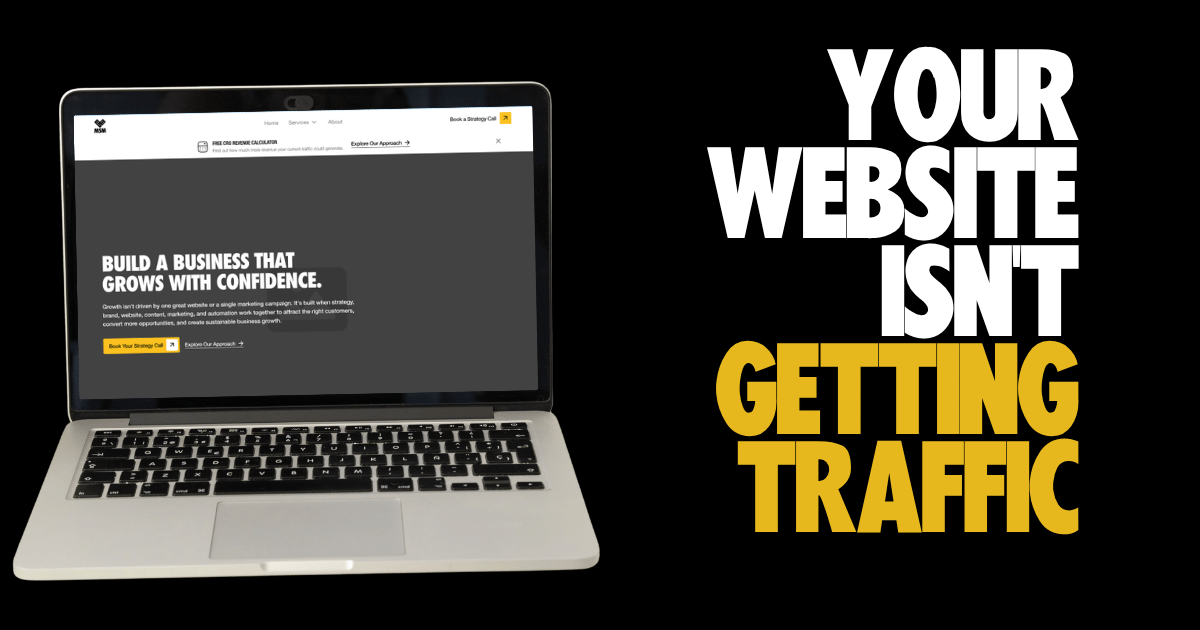
Before you rewrite your website, check where the numbers fall away. No impressions? Check indexing and search intent. Impressions but no clicks? Check rankings and the search result. Visitors but no enquiries? Check the conversion journey. The 15 checks below show you where to start.
A few years back we were asked to run a set of marketing campaigns, email and direct mail, for a tech company that had been trading for twenty years. Our remit was the campaigns. Website management wasn't part of it. They'd recently spent thousands on a new website and a full rebrand, and on the face of it, it looked good.
We ran the first campaign and, as expected, it generated a high volume of traffic to the website service page. The problem was what happened next. Zero conversions. Not 1% or 2%, zero. So even though the website had nothing to do with us, we ran a CRO audit, because numbers like that are unsustainable. Your website can't be the place where all your leads go to die.
The site was a mess underneath the amazing photography and stunning design work. The conversion setup was all over the place. Too many call to action buttons competing for attention. Social media links sitting right in the decision making zones, sending people away at the exact moment they should have been committing. A confusing customer journey with broken links. Promises to learn more about something specific that dumped the visitor onto a long lead form with no context at all. The SEO was poor. The marketing message was weak and barely mentioned half of what they actually did. There was no H1 or H2 structure and no authority anywhere on the page. It looked good, but it wasn't built to help customers learn, answer their questions, or take a clear next step. It was built to look nice.
This is a common theme. Businesses have a website they're immensely proud of. It looks great, so when the leads don't convert, it's almost impossible to accept that the website could be the cause. Naturally the unconscious bias points somewhere else, at the Google Ads spend, or the Meta campaign setup, or the creative. Anywhere but the site.
You can usually spot it. If you've got a campaign bringing hundreds of new visitors to your website every week, you've carefully worked out your ideal customer, you've built a clear message around their pain points and how you help, you've added real social proof, and the website still isn't converting, that's a big red flag that your website isn't working the way it should.
That was a conversion problem, and getting people to the site was never the issue. But the same blind spot works in reverse. When a website looks good, it's just as hard to accept that it might be the reason nobody's arriving in the first place.
A website with no visitors is a very expensive shop window, and it can be seriously frustrating. If you want to increase website traffic, the honest starting point is that most advice on the subject is years out of date, and Google has changed more in the last six months than it did in the previous ten.
At MSM we read Google's own documentation so you don't have to, and we test what drives the numbers on real client sites. This blog pulls both together. Below are fifteen reasons your website isn't getting traffic, each one checked against Google's current best practice as of May and June 2026, rather than the recycled tips still doing the rounds on Meta. Getting the traffic is only half the job, so we'll finish on the part most agencies typically ignore, turning that traffic into money.
Let's get into our fifteen top tips.
1. Your pages don't match what people are searching for
Before the tactics, it helps to understand how website traffic actually reaches you, because most of the fixes below map onto one stage of the same chain. It works like this. Keywords decide which searches you're even eligible to appear for. When you appear, that's an impression. When someone chooses to click your result, that's your click-through rate. Those clicks are your website traffic. Miss the first stage and you're invisible. Nail the keywords but write a weak title and you get impressions with no clicks. Get both right and the traffic follows. Almost every problem in this post sits somewhere on that chain.
Keyword research still matters. In fact it matters more now than ever before, but the old game of collecting long-tail phrases and sprinkling them through your copy is finished. Google's systems now understand synonyms and meaning, so you no longer need to capture every variation of how someone might phrase a search. Google says this plainly in its own guidance.
What still works is understanding what a searcher really wants when they type something in, and being the page that answers it best. Pick one clear topic per page, write for the person behind the query, and stop stuffing your page with keywords in the hope it might get you a few impressions. Keyword stuffing puts readers off, it won't increase website traffic, and it does nothing to help convert those readers into leads. Focus your content around solving problems, answering the typical questions your leads have, using the language they use, and you won't be far out.
2. Your content repeats what everyone else already says
This is the single biggest reason sites fail to grow, and it's the reason the original version of this post needed rewriting. Google's AI optimisation guide draws a hard line between commodity content and non-commodity content. "Seven tips for first-time buyers" is commodity. It's common knowledge, it could have come from anyone, and a machine could generate it in seconds.
Non-commodity content carries a first-hand point of view that only you could write. A real review from real use. A number from a real project. A lesson you learned the hard way. If your blog reads like a summary of what's already on the internet, it will struggle to earn website traffic no matter how tidy the SEO is. Write what you know, from experience, and you'll stand out to both readers and Google's ranking systems.
Most people these days run to Claude or ChatGPT and publish back what 99% of other users have already been given. There's nothing wrong with using AI to help, we do it too, but if you stop at the first draft it spits out, you're putting the same commodity content live as everyone else. Add your own data, your own opinion, and your own stories. That's the part a model can't copy, and it's the part Google rewards.

3. Google doesn't see your website as trustworthy yet
Plenty of sites quote the old three qualities of Expert, Authoritative and Trustworthy. Google added a fourth in December 2022, an extra E for Experience, and it's now the one that matters most. Experience means genuine first-hand involvement. Have you actually used the product, run the campaign, or sat in the room?
That extra E is not a coincidence. It's the same quality Google's AI features reward. The person who did the thing beats the person summarising it. Show your authors, prove they know the subject, keep a real About page, make it easy to contact you, and back it all with reviews. E-E-A-T is judged across your whole site, not one page at a time.
In practice this means real author bios with real credentials, case studies with real numbers, and content that could only have come from someone who does the work. It's slower than churning out generic posts, but it's the difference between a site Google trusts and one it quietly leaves out.
4. Your website shows up on Google but nobody clicks
There's a symptom the old advice loves to mention but never actually solves: high impressions, low click-through. That means Google is showing your page and people are choosing not to click. This is the impressions to clicks stage of the chain, and it's where a lot of traffic quietly leaks away. Nine times out of ten the culprit is your title link and your meta description, the two lines a searcher reads before deciding.
We know this one first-hand. On our own site we found factory placeholder text sitting in the meta descriptions of several blog posts, which meant Google was displaying a template's default line in the results instead of a reason to click. Impressions were climbing while clicks collapsed. Fixing the descriptions fixed the click-through. Check every important page, write a title and description that earn the click, and you'll increase website traffic without touching your rankings at all.
Think of it like a shop sign. You can be on the busiest street in town, but if the sign is blank, people walk straight past. Your title and description are that sign.
5. Your Google Business Profile is doing nothing for you
For a huge number of searches, your website isn't the first thing a potential customer sees. Your Google Business Profile is. It's the panel that shows on the right of the results and across Google Maps, with your name, reviews, photos, opening hours and services. For a local or service business, that profile is often the very first touchpoint someone has with your brand, and plenty of people decide whether to bother with you before they ever reach your website.
Google is clear about how this works. Local results are based mainly on three things: relevance, distance and prominence. Relevance is how well your profile matches the search, and you control that by filling it in properly. Your categories, your services, your products, a real business description, regular posts and good photos all tell Google exactly what you do and who you help. A vague, half-finished profile gives Google very little to work with, so it shows you less.
So claim it, verify it, and complete every single field. Pick the right primary category, list your services and products, write a description in the language your customers use, keep your hours accurate, and add fresh photos and posts. It costs nothing, it feeds Google Search, Maps and increasingly its AI answers, and it's one of the fastest ways to get in front of people who are ready to buy.
6. You haven't asked for Google reviews
This is the closest thing to a free lever we know, and most businesses ignore it. Google says prominence, one of its three local ranking factors, is partly based on how many reviews you have, and that more reviews and positive ratings can improve your local ranking. Reviews tell Google that real people trust you, that you do what you say you do, and that you're worth showing. They build the authority the last few tips talked about, in public, for nothing.
We've had countless businesses come to MSM because they can't get enough website traffic. Before we touch anything technical, we often tell them the same thing. Go and get as many genuine Google reviews as you can. We've watched businesses climb from around position fifteen to the top of the local results within days of doing it. That gets them seen, generates awareness right at the top of the funnel, and it costs precisely nothing.
A word of honesty here. Google states plainly that you cannot pay for or request a better ranking, and its policies ban fake reviews, so don't try to game it. Ask happy customers at the right moment, make it easy with a direct link, and reply to every review you get, good or bad. Do that consistently and you build a trust signal that both Google and your buyers can see.

7. Google's AI answers are keeping people from your site
If a post about website traffic doesn't mention AI search in 2026, it's already dated. Google now answers many searches with AI Overviews and AI Mode, which sit between the search and the click. They pull content from the normal Search index using a technique called grounding, then generate an answer with clickable links to the pages that support it. They also use query fan-out, firing off several related searches at once, which surfaces a wider and more diverse set of links than a classic result page.
The good news is there is nothing special to do. Google is explicit that there are no extra requirements and no secret optimisations for AI Overviews or AI Mode. If your page is indexed, allowed to show a snippet, and genuinely helpful, it's eligible. Solid content and clean technical foundations are the whole strategy. Google has also said clicks that come from AI Overviews tend to be higher quality, meaning those visitors are more likely to stick around, so being one of the linked sources is worth having.
8. You're wasting time on SEO tricks that don't work
As AI search grew, so did the snake oil. Google's guidance names the myths directly, and following them wastes your time. You do not need an llms.txt file or any special AI markup, because Google Search ignores them. You do not need to chop your content into tiny chunks. You do not need to rewrite everything in some robotic AI-friendly style. And chasing fake mentions across the web won't help.
Terms like GEO and AEO are just third-party labels. From Google's side, optimising for AI search is optimising for search, which is still SEO. Ignore the hacks and spend the effort on content and clarity instead. Every hour poured into a shortcut that doesn't work is an hour not spent on the fundamentals that do.
9. Google can't read your website properly
None of the above matters if Google can't crawl and index your pages properly. Make sure crawling is allowed in robots.txt and by your hosting, that important content is in real text rather than locked inside scripts, and that your pages load well and give a good page experience, including Core Web Vitals.
Watch your canonicals too. If your site serves both the www and non-www version of every page, or duplicates content across URLs, you split your own authority in two and confuse Google about which page to rank. Pick one canonical version, redirect the rest, and consolidate. It's unglamorous, and it's often the difference between a site that grows and one that stalls. If you want to see exactly what Google can and can't reach, the coverage and indexing reports in Search Console will show you.
10. Your website is hard to use on a phone
Google indexes the mobile version of your site by default, so mobile-first is not optional. Pages need to read without pinching or zooming, buttons need to be easy to tap, and forms need to be short enough to finish on a phone. Most of your visitors are on a phone, and if the experience is awkward, they leave before they ever become traffic that counts.
One quick correction to the old playbook: Google retired its standalone Mobile-Friendly Test tool at the end of 2023, so don't send people looking for it. Use the mobile view in Chrome's developer tools and the page experience data inside Search Console instead.
11. Your website pages aren't linked together
Google finds and understands your content partly through internal links, and it lists them as a core best practice. Yet most sites publish posts as islands with no route between them. Link related pages together, point readers from a blog to the relevant service, and build genuine depth around the topics you want to be known for. Strong internal linking spreads authority through your site and helps every page earn more website traffic.
It helps readers too. Someone who lands on a blog and finds a clear path to the service that solves their problem is far more likely to become an enquiry than someone left at a dead end.
12. Your traffic dropped after a Google update
This is where a lot of old SEO writing shows its age. Panda and Penguin were folded into Google's core ranking algorithm back in 2016. They are not separate, lurking penalties any more. The current language is core updates and spam updates.
Google runs broad core updates several times a year. They don't target individual sites, they reassess the whole web against what's genuinely helpful, and a drop doesn't mean your page is bad, just that others are now serving the searcher better. If you're hit, Google's own advice is to resist quick fixes, avoid ripping out random elements you heard were bad, and instead improve your site as a whole. Recovery can take weeks or months, and often lands on the next update. Panic changes tend to make things worse, not better.
13. You're relying on an old Google feature that's gone
Structured data still helps you qualify for rich results, and it's worth keeping as part of your wider SEO. But it is not required for AI search, and one popular tactic just died. As of May 2026, Google no longer shows FAQ rich results in Search, and it's removing the reporting and testing support through mid to late 2026.
So if your plan for more website traffic was to bolt FAQ schema onto every page, that lever is gone. Use structured data where it earns a real result, such as Article, Product, or Local Business markup, and make sure it matches the visible content on the page. Chasing features that no longer exist is a quiet way to waste a lot of effort.
14. Your happy customers can't tell Google to show more of you
Google added two features in May 2026 that reward exactly the kind of original, trusted work the earlier tips describe. Readers can now mark sites as Preferred Sources in their settings, and those sites get a preferred badge in Top Stories, AI Overviews and AI Mode. Any site publishing fresh content is eligible at domain level. Google reported people are twice as likely to click a Preferred Source. Encourage your audience to add you.
There's also a new Highly Cited badge that flags original reporting other articles reference. Both features point the same way. Publish primary, first-hand material worth citing, earn the trust and reviews from the tips above, and you'll be surfaced more often to the people most likely to buy.
15. You're getting website visitors but no leads or sales
Traffic that doesn't convert is a horrible metric to keep seeing. Clicks and impressions don't pay salaries, so our job as business owners is to quickly turn clicks into qualified leads. So, start by measuring properly in Search Console, G4A, where AI Overview and AI Mode clicks are already counted in your normal web traffic, so you can see what's really happening and where.
Then do the part almost every "get more traffic" article skips, which is conversion rate optimisation. If your website conversion rate is low (less than 3% as a very general rule of thumb) , every extra visitor just makes your marketing more expensive. Your cost per lead goes up, your cost per sale goes up, and your return on ad spend drops. A proper conversion rate optimisation audit finds where visitors hesitate and why, so you turn the traffic you already have into enquiries. This is also why we tell clients don't touch paid ads until your website can convert, because pouring spend onto a page that can't close is just faster leakage. The features that actually improve your conversion rate are covered in our guide to the 14 must-have features every SME website needs.
Let's Wrap This Up
More website traffic in 2026 comes down to the same core idea running through all of Google's current guidance. Publish original, experience-led content, get your free wins in place with a complete Google Business Profile and a steady flow of genuine reviews, keep your technical foundations clean, earn the click with sharp titles and descriptions, and then make sure the traffic converts. Chase hacks and you'll waste months.
Do the fundamentals well and you'll increase website traffic that turns into revenue within just a few weeks. And the best part, it won't break the bank
Interested in learning more about conversion rate optimisation?
Traffic is step one. Turning it into leads and sales is where the money is. These are the CRO reads worth your time next:
- Is Conversion Rate Optimisation Worth the Investment?
- What Is a Conversion Rate Optimisation Expert?
- How Much Does CRO Cost in the UK? (2026)
- Can Video Content Improve Website Conversion Rate?
- The Fear of Saying Yes: Why Your Customer Journey Is More Than a Buying Process
Conversion rate optimisation improves every step from attention to closed sale. Learn how MSM finds leaks across marketing, sales, CRM and follow-up.
How full-funnel marketing is transforming how businesses think about sales and marketing.